
Emirates (airline)
Flag carrier of Dubai; world's largest long haul airline.

Krixnadelapaz · CC BY-SA 4.0
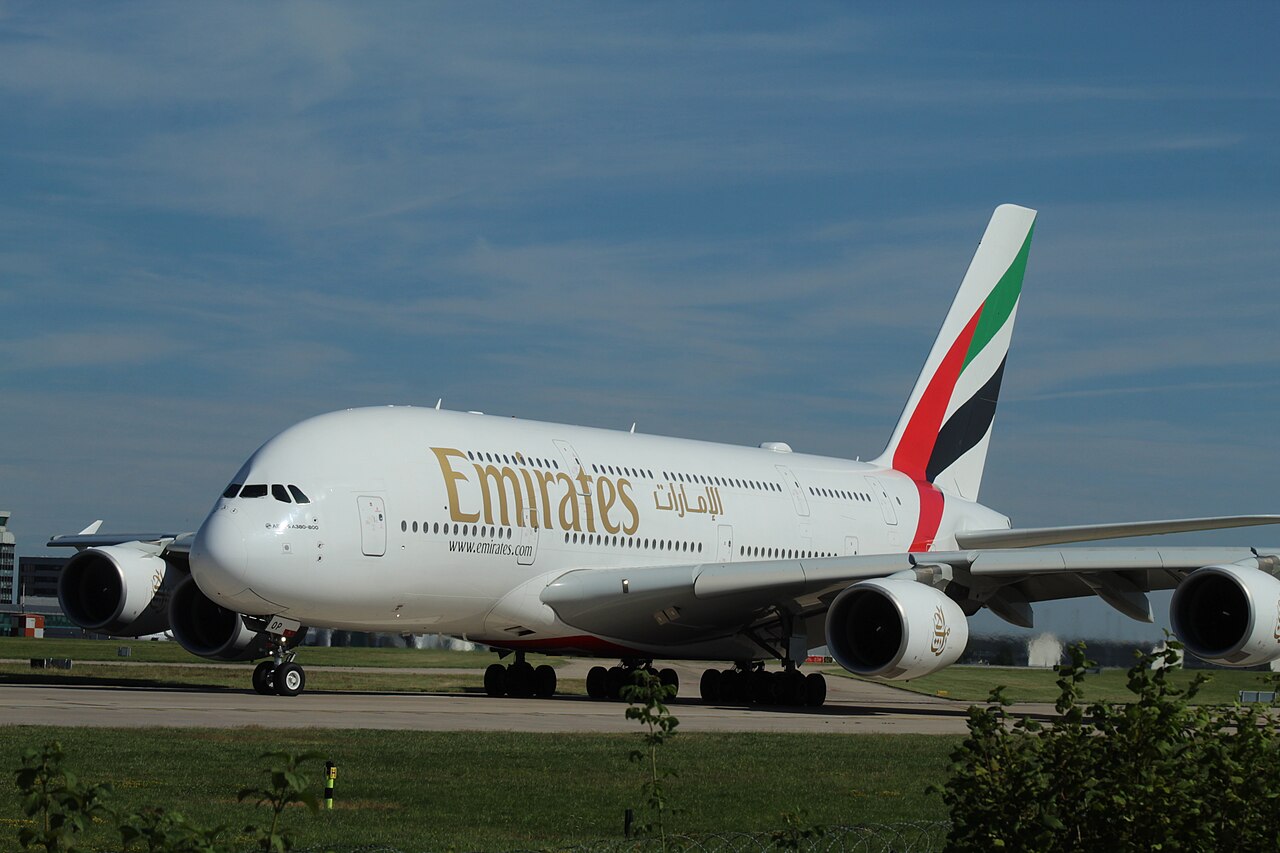
Emirates is one of the two flag carrier airlines of the United Arab Emirates, based in Al Garhoud, Dubai. The airline is a subsidiary of The Emirates Group, owned by the government of Dubai's Investment Corporation of Dubai.
- founder
- Ahmed bin Saeed Al Maktoum
- headquarters
- Al Garhoud, Dubai, United Arab Emirates
Lore & Background
Its first two aircraft were provided by Pakistan International Airlines, which also supplied free training for cabin crew. The airline started with $10 million in capital and was required to operate without government subsidies. The Gulf War boosted business as Emirates was the only airline flying in the last ten days of the conflict.
Reader's Guide
Its growth has been rapid and sustained, with the airline doubling in size every 3.5 years for its first 11 years and every four years thereafter. It has recorded a profit every year except its second, and has never seen annual growth fall below 20%. The airline's success has attracted criticism from competitors who claim unfair advantages and have called for an end to open-skies policies with the UAE. Its environmental and operational strategies, combined with its all-wide-body fleet, have made it a benchmark for long-haul air travel.
Did You Know?
- Emirates was founded with $10 million in start-up capital and was required to operate independently of government subsidies.
- Emirates has recorded a profit every year except its second year, and its growth has never fallen below 20% annually.
Pioneering the Region's Low-Cost Sky
That royal mandate made the carrier the first low-fare airline in the Middle East. What impressed observers most was its immediate financial discipline: the carrier broke even within its very first year of commercial operations. That early success set the stage for broader ambitions. In early 2007, Air Arabia opened its books to public investors through an initial public offering, selling 55 percent of its shares. The airline's headquarters sits in the Sharjah airport Freight Center, a property just fifteen kilometres from central Dubai, anchoring its identity firmly to the emirate that gave it life.
A Web of Joint Ventures Across Three Continents
Air Arabia grew far beyond a single Sharjah-based carrier by weaving a network of co-branded subsidiaries and joint ventures. In Nepal, a 2007 deal with Yeti Airlines spawned Fly Yeti, a short-lived but notable foray into South Asia.
An All-Airbus Identity and a Distinctive Livery
Air Arabia and its co-branded subsidiaries fly an exclusively Airbus A320-family fleet, a commitment that has defined its operational character since inception. Visually, the airline is unmistakable. Its livery paints the fuselage in red, grey, and white, with a stylized bird emblem representing Sharjah on the tail and engines.
Weathering Financial Storms
Air Arabia's financial journey has been marked by both resilience and sharp setbacks. The situation escalated when the carrier sued Abraaj founder Arif Naqvi in the Sharjah courts. Recovery was gradual. Despite these headwinds, the airline had reported figures exceeding AED 19 billion in the fourth quarter of 2019, underscoring the scale it had built before the disruptions hit.
Gallery

More in Companies And Conglomerates 1-21
Spotted an error? Know more?
This is a living reference — every entry is fact-audited, and reader corrections feed straight into our audit queue. Suggest an edit · See this site's audit record